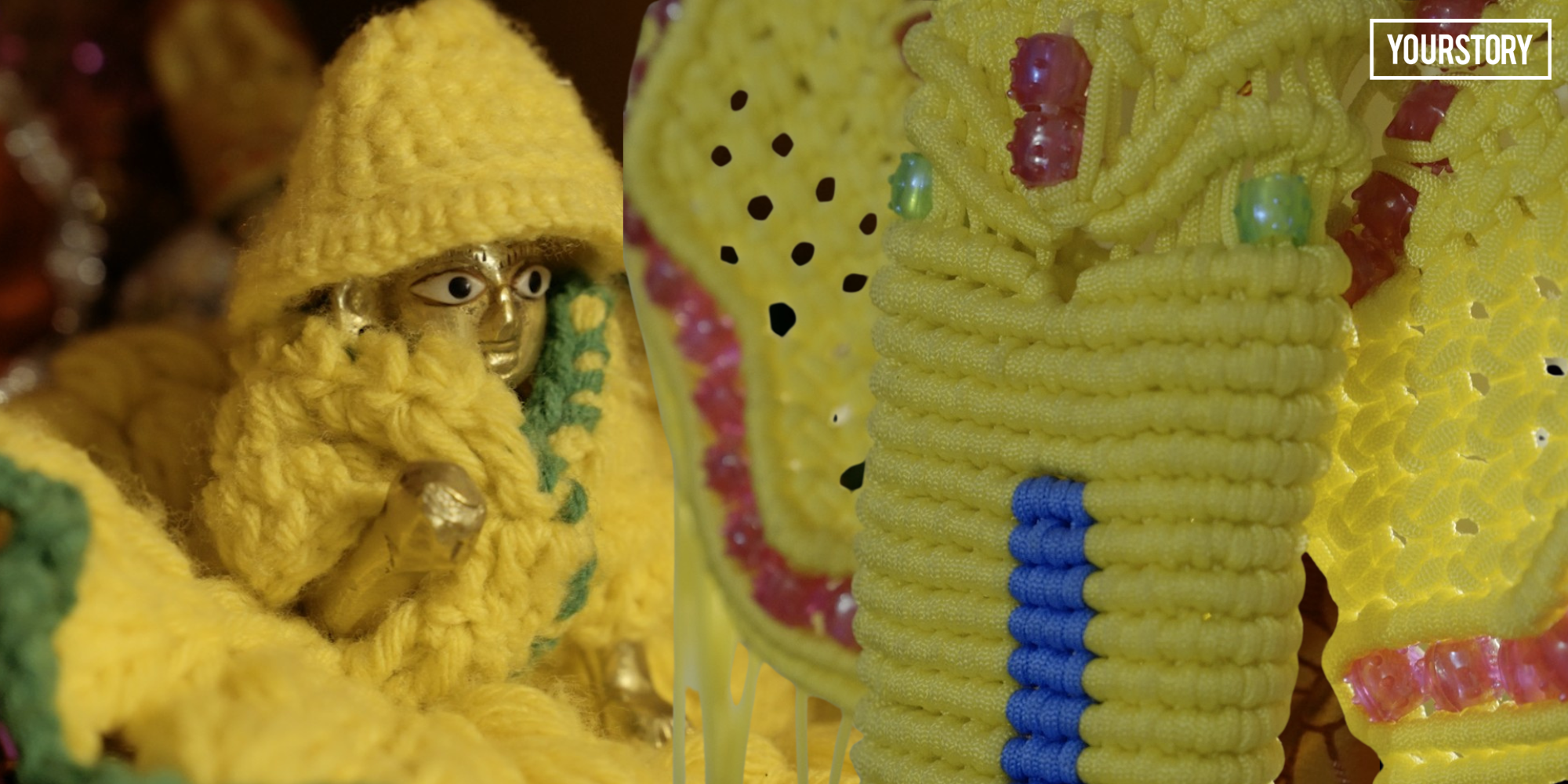
In Deoria, Uttar Pradesh, decorative handicrafts are woven into daily life. Sofa covers for new homes, cushion covers matching living rooms, and carefully stitched garments for Laddu Gopal idols are not occasional purchases—they are part of routine religious practice, gifting traditions, and household décor.
Behind each finished piece lies a chain of handwork carried out largely by women working from home. Under the One District One Product (ODOP) framework, decorative handicrafts and garments in Deoria have gained structured visibility, helping small producers connect with wider markets.
At the centre of one such initiative is Anjali Srivastava, who built a women-led production network that grew from a small local effort into a registered collective.
From Tutor to Organiser
Srivastava did not come from a craft background. She worked as a tutor, teaching zoology, chemistry, and English up to the intermediate level. During the pandemic, when her routine slowed, she began looking at how the skills of homemakers around her could be channelled into income generation.
“I realised many women already had the skill—they just needed direction and a platform,” she says.
She began with a group of 10 women, later registering the Aradhya Self Help Group in Deoria. As the work expanded, women from nearby districts like Gorakhpur and Kushinagar also joined. Over time, the network grew into a structured collective focused on practical, usable handicrafts.
Design, Devotion, and Digital Reach
The product range includes Laddu Gopal garments (for the infant form of Lord Krishna), sofa covers, cushion covers, and handmade bags. The idol garments form a signature line, designed in multiple variations to match regional traditions and preferences.
As demand increased, Srivastava adopted digital platforms such as Amazon and Flipkart to reach customers beyond local markets. Participation in trade fairs in Noida, Lucknow, Gorakhpur, and Maharajganj helped generate repeat buyers. She credits ODOP exhibitions for improving visibility.
For Srivastava, the principle is simple: “Skill becomes livelihood only when buyers can see it and trust it.”
In Deoria, that trust is being built through organised effort, steady production, and a collective of women turning home-based work into sustained income.
Author

prakhar@affmantra.com
Related Posts

8 Powerful Aldous Huxley quotes on society and solitude
Aldous Huxley remains one of the most influential thinkers of the twentieth century. While many readers know him as the author of...
Read out all
Kunal Kapoor launches MetaGO, a doctor-led metabolic health platform
Actor and entrepreneur Kunal Kapoor has launched MetaGO, a doctor-led metabolic health platform, betting that India’s rising burden of obesity and related...
Read out all
Pronto extends series B to $45M at $200M valuation
- 0
- 686 words
Home services startup Pronto has raised an additional $20 million in an extension of its Series B round, taking the total financing...
Read out all
Swiggy, magicpin, Zomato see food delivery regain growth momentum in December qtr
- 0
- 317 words
India’s top three food delivery players, Swiggy, magicpin, and Zomato, regained growth momentum in the October-December period after a period of slower...
Read out all
Health, safety, AI: test your business creativity with Edition 222 of our weekly quiz!
- 0
- 760 words
Lateral Sparks, the weekly quiz from YourStory, tests your domain knowledge, business acumen, and lateral thinking skills (see the previous edition here)....
Read out all
PhonePe’s merchant network cross 47 million businesses ahead of IPO
- 0
- 423 words
As PhonePe prepares for its Initial Public Offering (IPO), disclosures in its updated Draft Red Herring Prospectus (DRHP) shed light on the...
Read out all