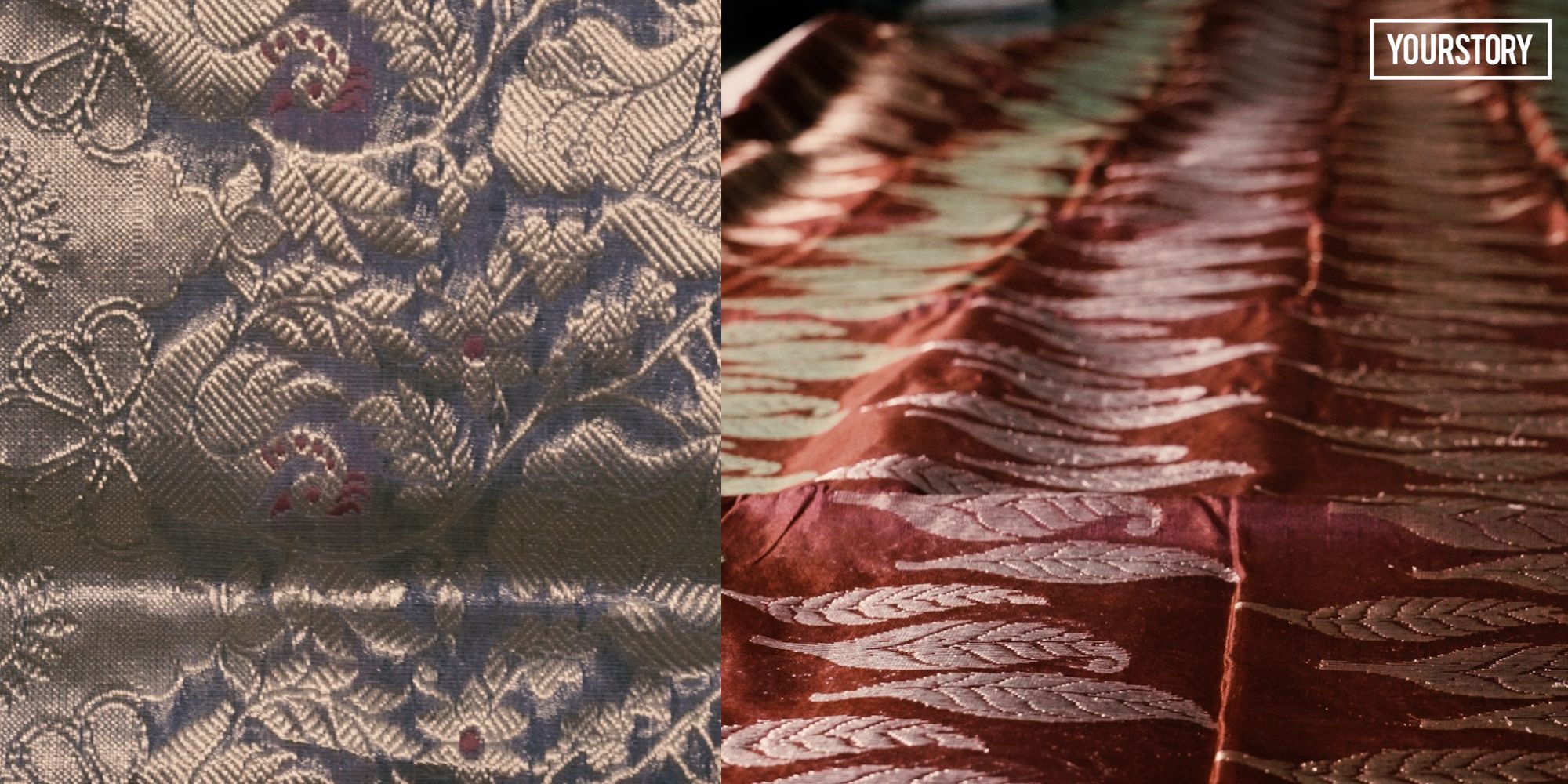
Across weddings and formal gatherings, zari-silk sarees are recognised for their sheen, intricate borders, and the graceful way the fabric falls. Behind each finished drape lies a detailed process that begins with yarn preparation and culminates on handlooms where precision is everything.
In Lalitpur district, handloom weavers produce zari-silk sarees along with dupattas and suit fabrics. Among them is Nitin Kumar Panth of Gandhi Nagar, who has been engaged in weaving for nearly 15 years. For him, preparing the threads is as critical as the weaving itself. The craft depends on exact thread alignment and steady coordination. A single loom setup may involve between 2,500 and 5,000 threads, and even a minor break can interrupt the workflow.
Learning the craft requires patience and observation. New learners typically spend months understanding loom handling, thread setting, and design placement before they are able to work independently. In Lalitpur, weaving is organised around homes and small workspaces rather than large factory units. The skill often passes through families and neighbourhood networks, with younger members assisting elders before gradually taking charge of the loom.
The work also demands sharp eyesight and sustained concentration. When a thread snaps, it must be carefully located, aligned, and joined to maintain uniformity in the weave. Even experienced weavers devote significant time to correcting such disruptions to ensure the final fabric maintains its finish and pattern continuity.
The production cycle begins with silk and zari yarn wound on small reels. These threads are grouped, stretched, and arranged across a frame before being mounted onto the loom. This preparatory stage frequently involves coordinated effort, with several individuals working together to ensure even distribution and tension. Once the loom is set, the design is programmed through a jacquard mechanism, guiding the shuttle as it moves back and forth to create the intended pattern.
Over time, both wages and finished product prices have evolved. Weaving compensation that once stood at a few hundred rupees per saree has increased significantly, while the retail value of finished zari-silk sarees now reflects the material quality and labour intensity involved in their making.
Through the One District One Product (ODOP) initiative, Lalitpur’s zari-silk weaving has gained wider exposure. Weavers have accessed jacquard equipment and participated in exhibitions and fairs in cities such as Greater Noida, Kanpur, and Lucknow, helping connect local production to broader markets.
Today, Lalitpur’s zari-silk sarees continue to carry forward a handloom tradition shaped by disciplined thread work, family-led learning, and careful craftsmanship—where each saree reflects the steady rhythm of the loom and the fine balance of thousands of interwoven threads.
Author

prakhar@affmantra.com
Related Posts

Kunal Kapoor launches MetaGO, a doctor-led metabolic health platform
Actor and entrepreneur Kunal Kapoor has launched MetaGO, a doctor-led metabolic health platform, betting that India’s rising burden of obesity and related...
Read out all
Pronto extends series B to $45M at $200M valuation
- 0
- 686 words
Home services startup Pronto has raised an additional $20 million in an extension of its Series B round, taking the total financing...
Read out all
Swiggy, magicpin, Zomato see food delivery regain growth momentum in December qtr
- 0
- 317 words
India’s top three food delivery players, Swiggy, magicpin, and Zomato, regained growth momentum in the October-December period after a period of slower...
Read out all
Health, safety, AI: test your business creativity with Edition 222 of our weekly quiz!
- 0
- 760 words
Lateral Sparks, the weekly quiz from YourStory, tests your domain knowledge, business acumen, and lateral thinking skills (see the previous edition here)....
Read out all
PhonePe’s merchant network cross 47 million businesses ahead of IPO
- 0
- 423 words
As PhonePe prepares for its Initial Public Offering (IPO), disclosures in its updated Draft Red Herring Prospectus (DRHP) shed light on the...
Read out all
Inside Etah’s Bell Workshops: Ghungroos, Temple Bells, and More
- 0
- 375 words
In Etah, Uttar Pradesh, sound is shaped through metal. Temple bells that mark prayer time, ghungroos tied to a dancer’s ankles, school...
Read out all