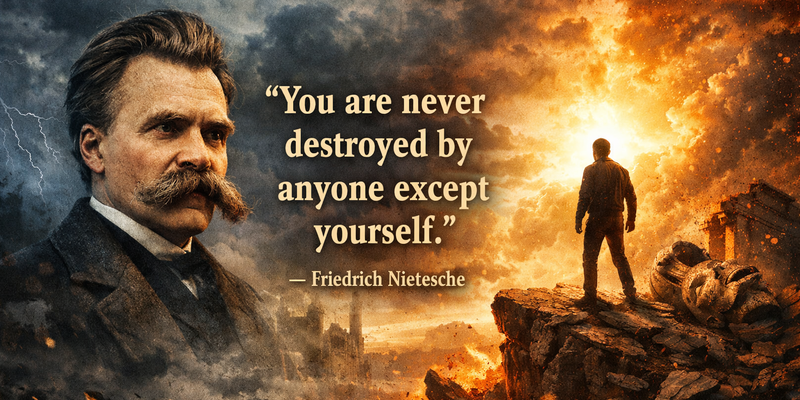
In a world quick to assign blame, Friedrich Nietzsche’s striking assertion feels both uncomfortable and empowering: “You are never destroyed by anyone except yourself.” The statement may initially seem severe, even dismissive of genuine suffering. Yet Nietzsche was not denying the existence of injustice or hardship. Rather, he was emphasising a deeper truth about human agency — that while others may wound you, only you can permit your own inner collapse.
The 19th-century German philosopher Friedrich Nietzsche consistently wrote about self-overcoming and personal responsibility. His philosophy centred on the idea that individuals must actively shape their own character instead of passively accepting the values imposed by society. To Nietzsche, destruction was not merely physical loss or external defeat. It was the surrender of one’s will, the quiet abandonment of courage, and the decision to stop striving.
This perspective does not ignore pain. People experience betrayal, loss, criticism, and systemic obstacles. Careers fail. Relationships end. Reputations are questioned. These events can deeply affect an individual. However, Nietzsche distinguished between being harmed and being destroyed. Harm comes from the outside. Destruction begins within.
Modern psychology reflects this insight. Therapies such as cognitive behavioural therapy emphasise that it is not events themselves that break people, but the meanings they assign to those events. Two individuals may experience the same setback. One internalises it as proof of permanent inadequacy, while the other views it as feedback for growth. The event is identical. The interpretation differs. And that interpretation shapes the outcome.
Self-destruction often occurs quietly. It appears in prolonged resentment, chronic self-doubt, avoidance of responsibility, or repeated negative patterns. Over time, these habits erode confidence and agency. When individuals define themselves entirely by what has happened to them, they surrender the power to redefine what happens next.
Nietzsche’s broader philosophy, including his idea of the “will to power,” reinforces this theme. He believed that human beings possess an intrinsic drive to expand, grow, and transform. Suffering, in his view, could become a catalyst rather than a conclusion. The question was not whether hardship would arrive, but whether one would allow hardship to dictate identity.
In today’s climate, where external pressures are constant and visible, it is easy to feel overwhelmed. Social media amplifies comparison. Economic challenges strain stability. Professional competition intensifies. Blame can feel justified. Yet Nietzsche’s message shifts focus from circumstance to response. It invites radical self-ownership.
This does not mean ignoring injustice or pretending adversity does not exist. It means recognising that resilience is an internal decision. While you may not control events, you always retain influence over reaction. Growth begins when responsibility replaces resignation.
Ultimately, Nietzsche’s quote is less a reprimand and more a call to empowerment. It challenges individuals to examine where they may be surrendering power through fear, stagnation, or self-limiting beliefs. True destruction is rarely imposed overnight. It unfolds gradually when ambition fades and agency is relinquished.
Conversely, true strength also builds gradually — through reflection, discipline, and deliberate choice. You may be hurt by others. You may face obstacles beyond your control. But you are only destroyed when you decide you can no longer rise.
In that realisation lies freedom.
Author

prakhar@affmantra.com
Related Posts

Kunal Kapoor launches MetaGO, a doctor-led metabolic health platform
Actor and entrepreneur Kunal Kapoor has launched MetaGO, a doctor-led metabolic health platform, betting that India’s rising burden of obesity and related...
Read out all
Pronto extends series B to $45M at $200M valuation
- 0
- 686 words
Home services startup Pronto has raised an additional $20 million in an extension of its Series B round, taking the total financing...
Read out all
Swiggy, magicpin, Zomato see food delivery regain growth momentum in December qtr
- 0
- 317 words
India’s top three food delivery players, Swiggy, magicpin, and Zomato, regained growth momentum in the October-December period after a period of slower...
Read out all
Health, safety, AI: test your business creativity with Edition 222 of our weekly quiz!
- 0
- 760 words
Lateral Sparks, the weekly quiz from YourStory, tests your domain knowledge, business acumen, and lateral thinking skills (see the previous edition here)....
Read out all
PhonePe’s merchant network cross 47 million businesses ahead of IPO
- 0
- 423 words
As PhonePe prepares for its Initial Public Offering (IPO), disclosures in its updated Draft Red Herring Prospectus (DRHP) shed light on the...
Read out all
Inside Etah’s Bell Workshops: Ghungroos, Temple Bells, and More
- 0
- 375 words
In Etah, Uttar Pradesh, sound is shaped through metal. Temple bells that mark prayer time, ghungroos tied to a dancer’s ankles, school...
Read out all