Across India, jaggery is part of daily life. It sweetens tea, shapes winter sweets, enters festive kitchens, and is used in home remedies passed down through generations. Sold in compact solid blocks, gud travels easily through wholesale markets and small-town trade routes.
In Ayodhya, Uttar Pradesh, jaggery production is closely linked to sugarcane cultivation and irrigation patterns. What appears on shop counters as a brown block is, in fact, the outcome of a tightly timed workflow that begins at the farm gate and concludes at the boiling pan.
Ankit Verma from Ajna village has been associated with the jaggery trade for the past three years. His unit functions on a straightforward model – procure cane from nearby farmers, process it quickly, convert it into gud, and sell the finished stock directly to traders who lift the material from the production site. The business operates on momentum—cane cannot wait, and cash flow cannot stall.
From Procurement to Crushing
The cycle begins with sugarcane purchase. Farmers bring cane to the local weighing point, where it is measured before unloading. Timing is important; once harvested, cane must be processed before it begins losing moisture.
The cane is then fed into a crusher setup powered by a motor, engine, or generator. The crushing mechanism presses and extracts juice through a series of rollers and levers designed for steady throughput. The extracted juice flows into a collection tank positioned beside the unit.
This stage sets the rhythm for the rest of the operation. The faster the crushing, the quicker the juice can move to the next phase.
Boiling, Reduction, and Setting
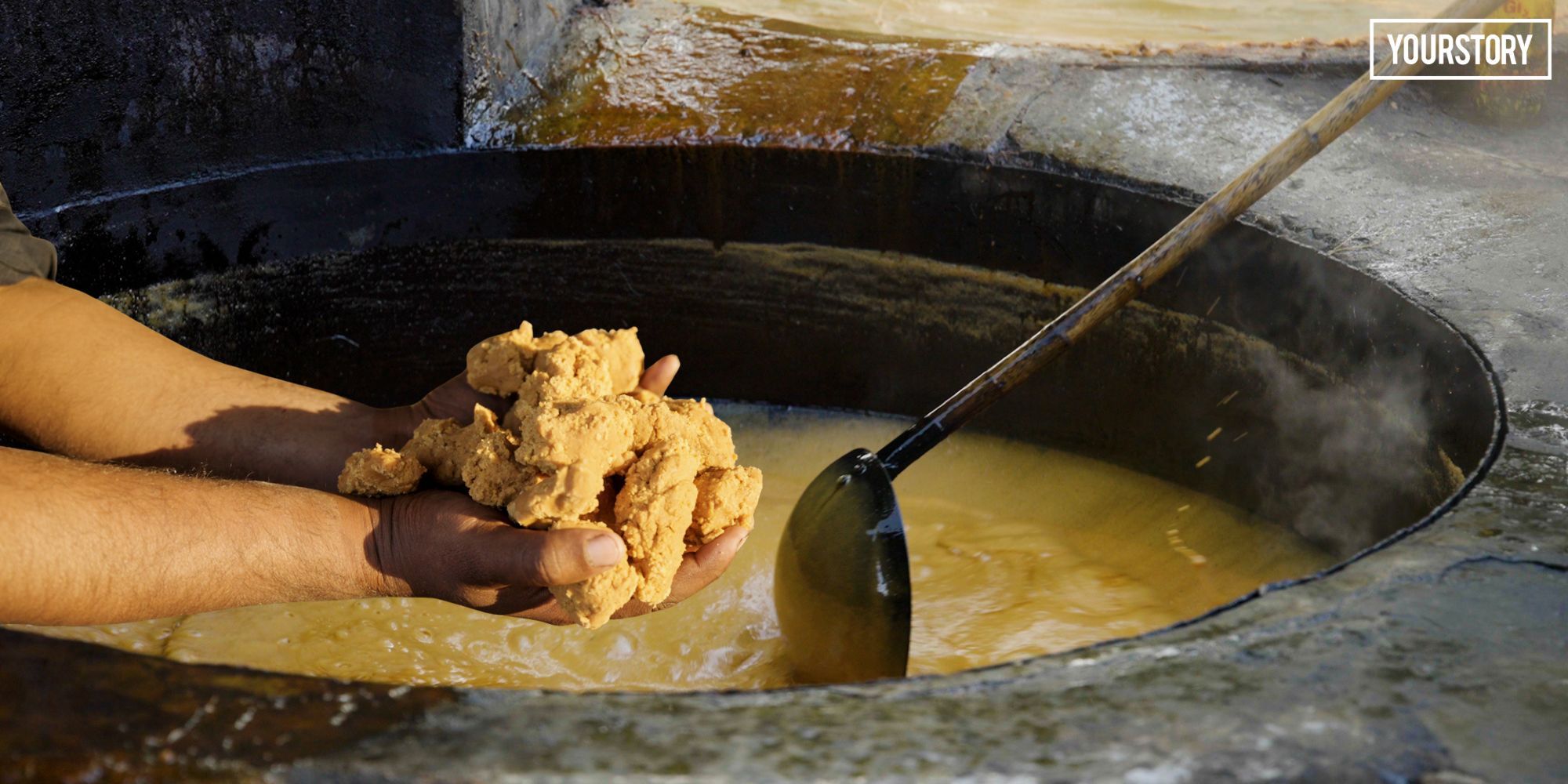
From the tank, the juice is transferred into a large iron pan placed over a furnace. Heat is applied continuously, reducing the liquid volume. As water content evaporates, the juice thickens and gradually transforms into a dense, golden-brown mass.
The boiling stage demands attention to temperature and timing. Once the consistency reaches the required thickness, the reduced syrup is handled in batches and allowed to set into solid form.
The finished output becomes trader-ready stock. Verma explains that jaggery is commonly packed in 20 kg cartons, while larger lots are dispatched when production volumes are higher. The blocks are stacked, counted, and kept ready for immediate lifting.
Market Movement and Cash Cycles
Unlike retail-focused businesses, this model is wholesale-driven. Buyers often arrive directly at the kolhu (jaggery making unit), complete the transaction in cash, and transport the jaggery to markets such as Gonda, Amethi, Sultanpur, Gorakhpur, and Lucknow.
This direct-lift model reduces the need for the producer to manage distant distribution networks. Instead, the emphasis remains on maintaining production speed and ensuring that batches are ready when traders arrive.
For producers like Verma, jaggery represents a farm-linked enterprise that converts a perishable crop into a storable commodity. Sugarcane, once crushed and reduced, gains a longer shelf life and can move in bulk quantities across district markets.
Under the One District One Product (ODOP) framework, jaggery has been positioned as a district-aligned activity that connects agriculture with small-scale processing. The linkage highlights how localized production units convert raw farm output into tradable goods that circulate through regional trade corridors.
In Ayodhya’s jaggery clusters, the workflow remains compact but continuous—cane procurement, crushing, boiling, batch setting, packing, and trader dispatch. From field to furnace to freight, the cycle converts seasonal harvest into structured market supply, sustaining a trade that moves quietly yet steadily across Uttar Pradesh’s wholesale networks.
Author

prakhar@affmantra.com
Related Posts

Kunal Kapoor launches MetaGO, a doctor-led metabolic health platform
Actor and entrepreneur Kunal Kapoor has launched MetaGO, a doctor-led metabolic health platform, betting that India’s rising burden of obesity and related...
Read out all
Pronto extends series B to $45M at $200M valuation
- 0
- 686 words
Home services startup Pronto has raised an additional $20 million in an extension of its Series B round, taking the total financing...
Read out all
Swiggy, magicpin, Zomato see food delivery regain growth momentum in December qtr
- 0
- 317 words
India’s top three food delivery players, Swiggy, magicpin, and Zomato, regained growth momentum in the October-December period after a period of slower...
Read out all
Health, safety, AI: test your business creativity with Edition 222 of our weekly quiz!
- 0
- 760 words
Lateral Sparks, the weekly quiz from YourStory, tests your domain knowledge, business acumen, and lateral thinking skills (see the previous edition here)....
Read out all
PhonePe’s merchant network cross 47 million businesses ahead of IPO
- 0
- 423 words
As PhonePe prepares for its Initial Public Offering (IPO), disclosures in its updated Draft Red Herring Prospectus (DRHP) shed light on the...
Read out all
Inside Etah’s Bell Workshops: Ghungroos, Temple Bells, and More
- 0
- 375 words
In Etah, Uttar Pradesh, sound is shaped through metal. Temple bells that mark prayer time, ghungroos tied to a dancer’s ankles, school...
Read out all