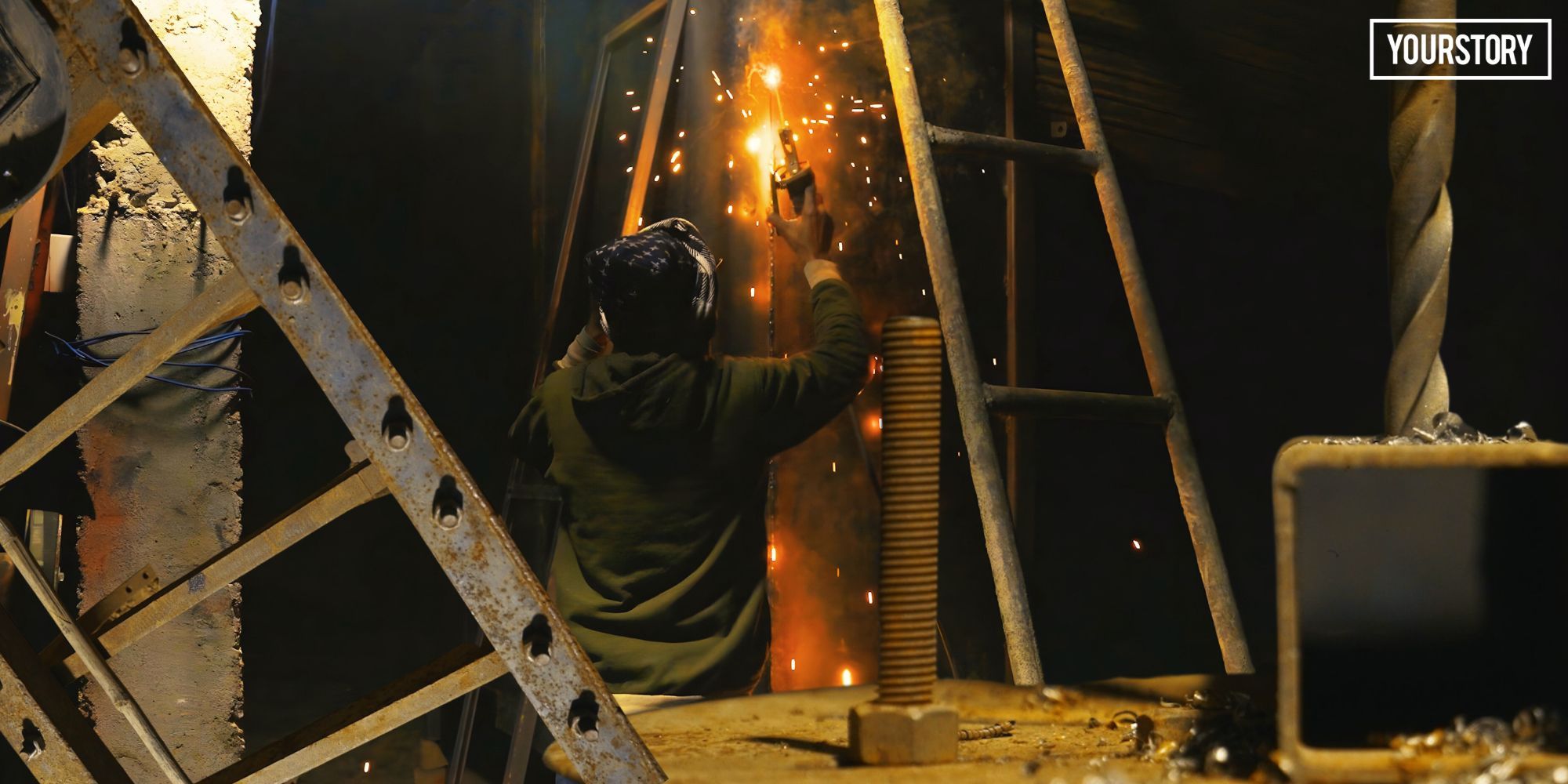
In Hamirpur district of Uttar Pradesh, metal products are recognised as one of the notified categories under the One District One Product (ODOP) programme. Across the district, workshops transform raw iron into a wide range of practical items used in agriculture, construction, and daily rural life. These metal products form an important part of the local economy, supplying tools and fixtures that keep farms, homes, and small businesses functioning.
In regions like Bundelkhand, farming and household infrastructure rely heavily on durable equipment that can withstand regular use. Local metal-product units respond to this demand by manufacturing items that farmers, traders, and households need throughout the year. Agricultural implements such as cultivators, seeders, harrows, tillers, and trolleys are produced alongside structural products like iron gates, grills, chowkhat frames, and shutter fittings.
The work in these units often follows a straightforward cycle. Raw material arrives as iron sections, sheets, and channels, which are then cut, welded, assembled, and finished into usable products. Some items are prepared in advance based on common demand, while others are produced according to specific orders placed by farmers or households.
A workshop in Chandot village
Among the people engaged in this sector is Asend Rajput, a resident of Chandot village in the Sarila area of Hamirpur district. Rajput operates a unit where different types of metal products are manufactured through welding and fabrication processes, responding to orders that come from nearby villages and surrounding areas.
He explains that the unit produces agricultural implements used by farmers as well as metal fixtures used in homes and buildings. Farmers approach the workshop for equipment required during cultivation seasons, while households and small contractors place orders for gates, grills, or structural frames.
Rajput says the idea of starting the workshop was rooted in the intention to create a work facility within the village itself. By setting up the unit locally, he hoped to generate employment opportunities and ensure that people in nearby villages could access metal products without travelling to distant towns.
The workshop in Chandot developed gradually. Rajput recalls that the initial step was to establish a basic workspace by building a boundary wall around the site. A tin shed was later installed to house machinery and protect the workspace. As orders increased and the work stabilised, additional machines were introduced to support different stages of production.
Before starting the unit, Rajput had already seen similar work taking place in nearby towns and villages. Observing those workshops helped him understand the processes involved in producing metal products. Drawing from that experience, he began his own unit using personal savings and later sought financial assistance when machinery requirements increased.
From raw iron to finished metal products
The manufacturing process in such units begins with the arrival of raw iron, commonly referred to as loha. The material is supplied in different forms such as sheets, angles, and channels, depending on the product that needs to be made.
The first step involves cutting the metal sections into required shapes and sizes. These pieces are then joined through welding to create the basic structure of the product. Once the framework is completed, additional components are assembled and fitted. The final stage usually involves finishing and painting before the product is delivered to the buyer.
Rajput explains the process using the example of a farm trolley. Work begins with preparing the chassis, which forms the main structure of the trolley. After that, fittings related to load support are attached. Springs and axles are installed next, followed by construction of the body. Once the assembly is complete, the trolley is painted and made ready for use.
A similar process is followed for agricultural implements such as cultivators, harrows, and seeders. Each of these tools requires strong metal joints and careful assembly so that they can perform reliably during farm operations.
Alongside agricultural tools, the workshop also produces metal products used in homes and small construction projects. Gates, grills, and chowkhat frames are fabricated according to the measurements provided by customers. Shutter fittings and other welding-related jobs are also undertaken based on local requirements.
Rajput also mentions that certain assignments involve job work connected to machines used for loading sand in nearby areas. Such work further links the workshop to different economic activities taking place in the region.
Most buyers come from nearby villages and surrounding localities. Farmers purchase implements needed for cultivation, while households and builders approach the workshop for structural metal items. To serve immediate demand, Rajput keeps some finished products ready in the workshop. At the time of speaking, he mentions having cultivators, a trolley, and harrows prepared and kept aside for buyers.
Support through the ODOP programme
Rajput says he accessed financial assistance through the ODOP scheme to strengthen his workshop’s capacity. Through the programme, he obtained a loan of approximately ₹5 lakh, which allowed him to purchase machinery and expand production activities.
He also recalls participating in a training session organised through a call-based format, where information related to the sector and available support mechanisms was shared.
Continuing the metal products tradition
Looking ahead, Rajput plans to expand the range of metal products manufactured within his unit. At present, some components are sourced from external markets, but he aims to gradually produce more parts locally and supply them to nearby shops and buyers.
For him, Hamirpur’s metal-products sector operates through a simple balance of raw material supply, practical manufacturing skills, and steady demand from rural areas. Together, these elements sustain the workshops that produce the tools and structures used across farms, homes, and local markets in the district.
Author

prakhar@affmantra.com
Related Posts

Kunal Kapoor launches MetaGO, a doctor-led metabolic health platform
Actor and entrepreneur Kunal Kapoor has launched MetaGO, a doctor-led metabolic health platform, betting that India’s rising burden of obesity and related...
Read out all
Pronto extends series B to $45M at $200M valuation
- 0
- 686 words
Home services startup Pronto has raised an additional $20 million in an extension of its Series B round, taking the total financing...
Read out all
Swiggy, magicpin, Zomato see food delivery regain growth momentum in December qtr
- 0
- 317 words
India’s top three food delivery players, Swiggy, magicpin, and Zomato, regained growth momentum in the October-December period after a period of slower...
Read out all
Health, safety, AI: test your business creativity with Edition 222 of our weekly quiz!
- 0
- 760 words
Lateral Sparks, the weekly quiz from YourStory, tests your domain knowledge, business acumen, and lateral thinking skills (see the previous edition here)....
Read out all
PhonePe’s merchant network cross 47 million businesses ahead of IPO
- 0
- 423 words
As PhonePe prepares for its Initial Public Offering (IPO), disclosures in its updated Draft Red Herring Prospectus (DRHP) shed light on the...
Read out all
Inside Etah’s Bell Workshops: Ghungroos, Temple Bells, and More
- 0
- 375 words
In Etah, Uttar Pradesh, sound is shaped through metal. Temple bells that mark prayer time, ghungroos tied to a dancer’s ankles, school...
Read out all