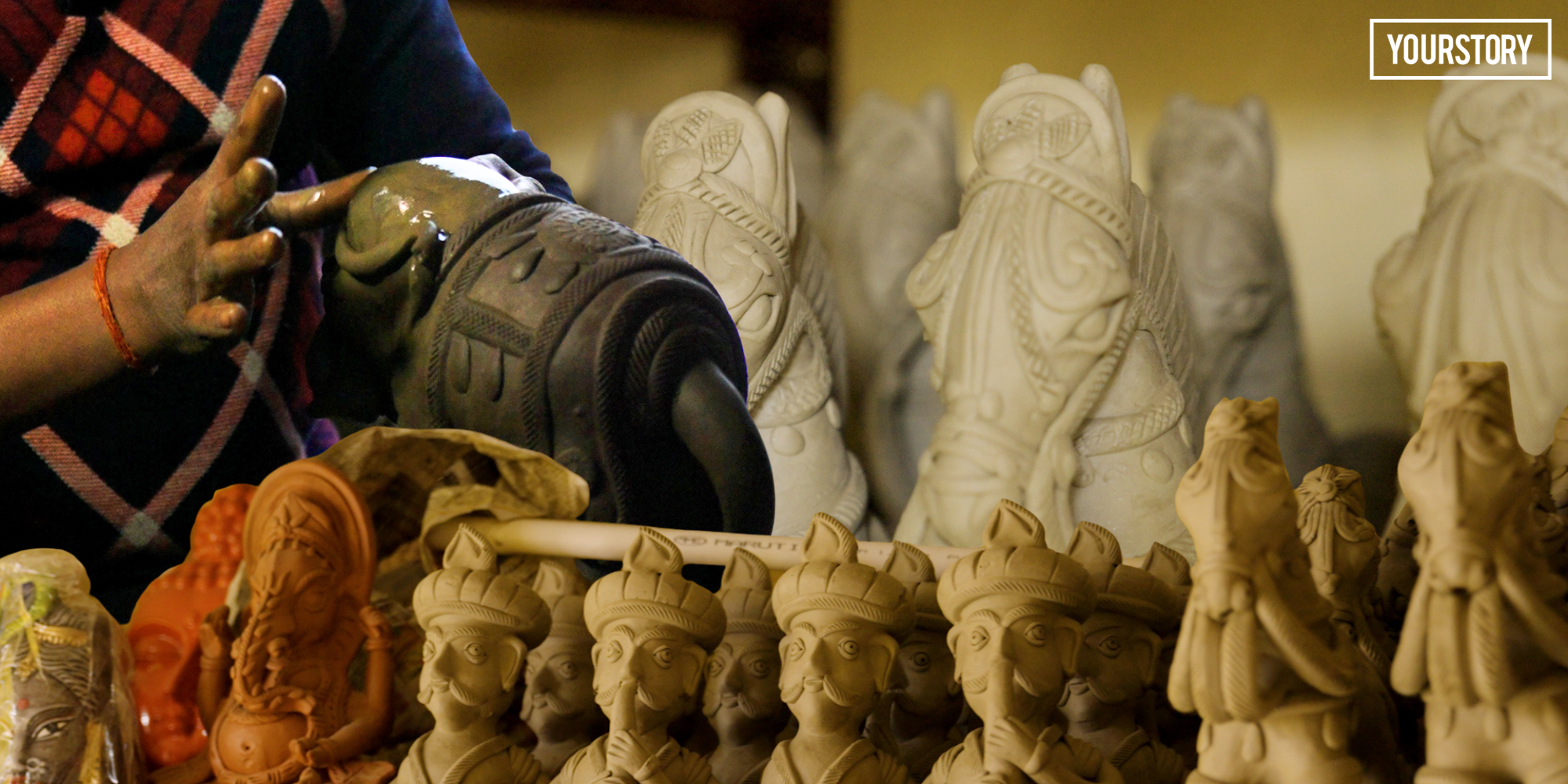
In Gorakhpur, Uttar Pradesh, terracotta is not just decorative—it is a working livelihood. Clay figures shaped in village courtyards travel to city markets, exhibition stalls, and retail counters across India. What begins as raw earth in Aurangabad village often ends up on shelves in metropolitan homes.
The supply chain links artisans, local traders, transporters, and exhibition organisers. Under the One District One Product (ODOP) framework, Gorakhpur’s terracotta has gained structured visibility, enabling artisans to access credit, better tools, and broader market platforms.
A Craft Learned at Home
Hiralal Prajapati, a terracotta artisan from Aurangabad village, represents this continuity. He learned by observing his father—returning from school and gradually taking on small tasks.
“I did not learn it in a day,” he says. “The hands learn slowly.”
For over 15 years, he has shaped elephants, horses, camels, Ganesha idols, and decorative pieces. The work is entirely hand-driven, relying on steady shaping and proportion control rather than mould-based shortcuts.
From Form to Finish
The process begins with preparing clay, now assisted by a clay-making machine. Pieces are shaped on an electric wheel and left to partially dry. Once the form stabilises, detailing begins. Prajapati uses a simple steel knife to carve patterns and define features.
A terracotta horse takes shape step by step—neck, tail, base, and hooves assembled before carving. Larger pieces demand both scale and patience; a three-foot elephant can be priced at around ₹5,000.
Bulk orders often define the workshop’s pace. Prajapati recalls fulfilling an order of 400 pieces following an exhibition. “When orders come, the whole routine changes,” he notes.
Markets and Momentum
With support from ODOP, Prajapati availed a loan of ₹1 lakh and received improved tools that boosted efficiency. However, he believes easier access to lower-interest credit would further strengthen artisan capacity.
Terracotta from Gorakhpur now reaches Lucknow, Delhi, Mumbai, Pune, Nagpur, Kanpur, and Varanasi—primarily through traders who source directly from village workshops.
For Prajapati, repeat buyers remain the simplest validation. “If people come back, it means the work holds,” he says.
In Gorakhpur, terracotta moves steadily—from clay to kiln to city shelves—sustaining hands that shape tradition into livelihood.
Author

prakhar@affmantra.com
Related Posts

8 Powerful Aldous Huxley quotes on society and solitude
Aldous Huxley remains one of the most influential thinkers of the twentieth century. While many readers know him as the author of...
Read out all
Kunal Kapoor launches MetaGO, a doctor-led metabolic health platform
Actor and entrepreneur Kunal Kapoor has launched MetaGO, a doctor-led metabolic health platform, betting that India’s rising burden of obesity and related...
Read out all
Pronto extends series B to $45M at $200M valuation
- 0
- 686 words
Home services startup Pronto has raised an additional $20 million in an extension of its Series B round, taking the total financing...
Read out all
Swiggy, magicpin, Zomato see food delivery regain growth momentum in December qtr
- 0
- 317 words
India’s top three food delivery players, Swiggy, magicpin, and Zomato, regained growth momentum in the October-December period after a period of slower...
Read out all
Health, safety, AI: test your business creativity with Edition 222 of our weekly quiz!
- 0
- 760 words
Lateral Sparks, the weekly quiz from YourStory, tests your domain knowledge, business acumen, and lateral thinking skills (see the previous edition here)....
Read out all
PhonePe’s merchant network cross 47 million businesses ahead of IPO
- 0
- 423 words
As PhonePe prepares for its Initial Public Offering (IPO), disclosures in its updated Draft Red Herring Prospectus (DRHP) shed light on the...
Read out all