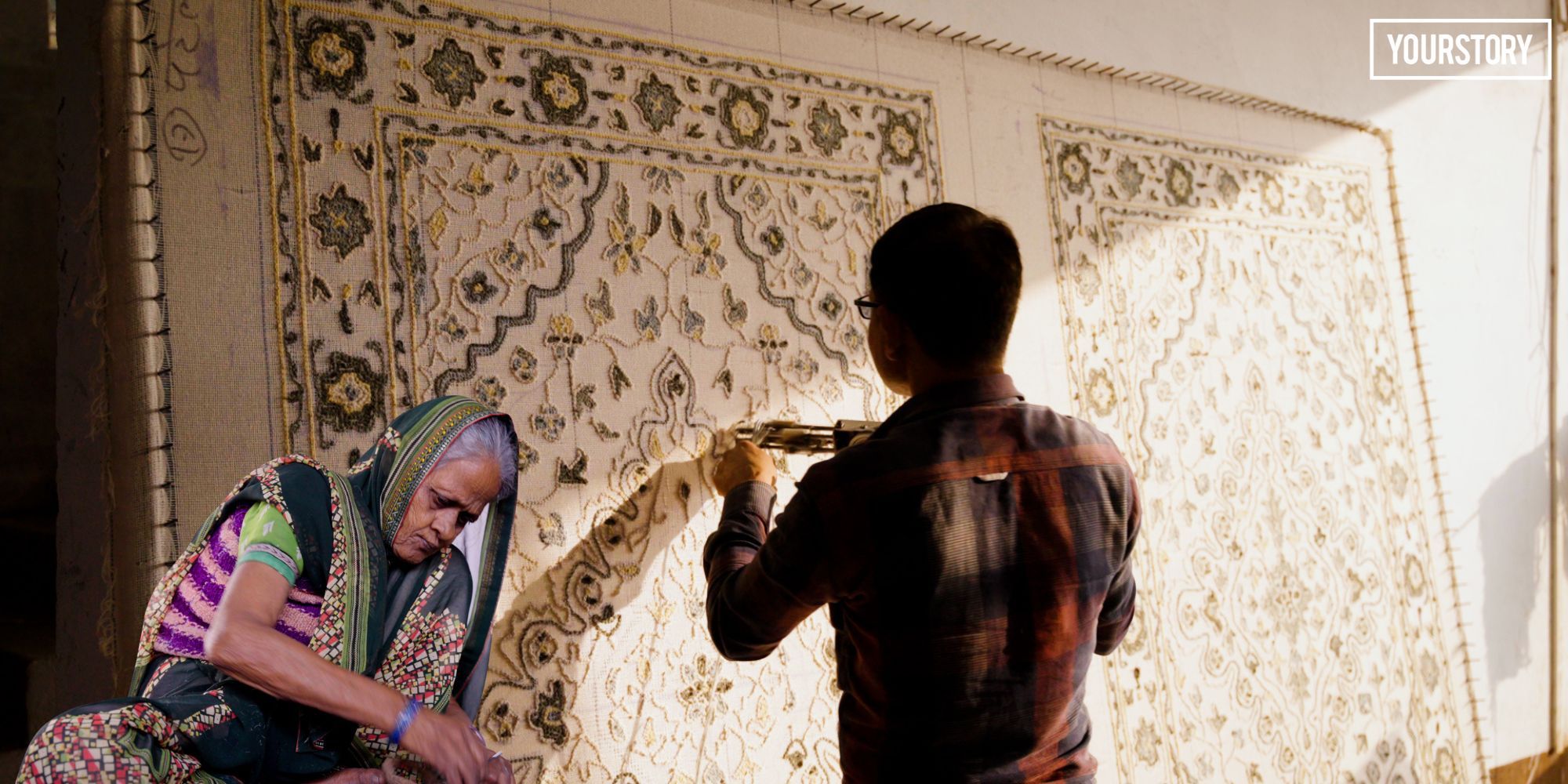
Sant Ravidas Nagar, widely known as Bhadohi, Uttar Pradesh — carpets are not just floor coverings. They are a signature craft that travels from local looms to living rooms across India and overseas. Whether placed in homes, prayer spaces, or gifted at weddings, each carpet reflects a labour-intensive process rooted in the district’s weaving culture.
The carpet industry sustains a layered livelihood chain — from loom operators and yarn dyers to designers, finishers, packers, and traders. The district forms part of India’s largest handmade carpet belt, where production is often distributed across villages rather than confined to a single factory.
Under the ODOP framework, carpets have received structured recognition, enabling units to access schemes, subsidies, and exhibition platforms that strengthen their market reach.
A Craft Learned at Home
Sanjay Kumar Maurya, proprietor of CL International in Gopiganj, represents this generational continuity. His journey began with his grandfather and father, before he formally registered his company in 2007.
“In our homes, the loom is part of daily life,” he says. “You learn by watching long before you start weaving.”
Rather than centralising production, Maurya built a distributed network model — assigning different stages of work across groups. This structure ensures flexibility when demand rises and keeps more families connected to the craft.
From Order to Finished Carpet
Carpet production begins with order specifications. The district produces multiple formats:
- Hand-knotted carpets – each knot tied individually for density and durability
- Hand-tufted carpets – yarn inserted using a tufting tool
- Tibetan weave styles – yarn looped over rods and cut to shape
- Handloom carpets and durries
Yarn is sourced externally, dyed according to design requirements, and mapped into patterns before weaving begins. After weaving, carpets move through trimming, washing, stretching, and finishing before final inspection and packing.
Quality is judged by weave density, design clarity, and finishing precision.
Cluster Strength and Scale
Maurya estimates that several hundred artisans may be engaged across distributed teams when orders are active. The cluster model allows production continuity even if one unit slows down.
He credits ODOP-linked access to schemes and subsidies — typically in the 10–15% range — for making expansion more viable for smaller units.
For Maurya, the strength of Sant Ravidas Nagar’s carpet industry lies in its adaptability:
“When more hands stay connected to the loom, the work survives.”
In Bhadohi’s carpet belt, the journey from loom to living room is sustained by tradition, distributed labour, and consistent global demand.
Author

prakhar@affmantra.com
Related Posts

Kunal Kapoor launches MetaGO, a doctor-led metabolic health platform
Actor and entrepreneur Kunal Kapoor has launched MetaGO, a doctor-led metabolic health platform, betting that India’s rising burden of obesity and related...
Read out all
Pronto extends series B to $45M at $200M valuation
- 0
- 686 words
Home services startup Pronto has raised an additional $20 million in an extension of its Series B round, taking the total financing...
Read out all
Swiggy, magicpin, Zomato see food delivery regain growth momentum in December qtr
- 0
- 317 words
India’s top three food delivery players, Swiggy, magicpin, and Zomato, regained growth momentum in the October-December period after a period of slower...
Read out all
Health, safety, AI: test your business creativity with Edition 222 of our weekly quiz!
- 0
- 760 words
Lateral Sparks, the weekly quiz from YourStory, tests your domain knowledge, business acumen, and lateral thinking skills (see the previous edition here)....
Read out all
PhonePe’s merchant network cross 47 million businesses ahead of IPO
- 0
- 423 words
As PhonePe prepares for its Initial Public Offering (IPO), disclosures in its updated Draft Red Herring Prospectus (DRHP) shed light on the...
Read out all
Inside Etah’s Bell Workshops: Ghungroos, Temple Bells, and More
- 0
- 375 words
In Etah, Uttar Pradesh, sound is shaped through metal. Temple bells that mark prayer time, ghungroos tied to a dancer’s ankles, school...
Read out all