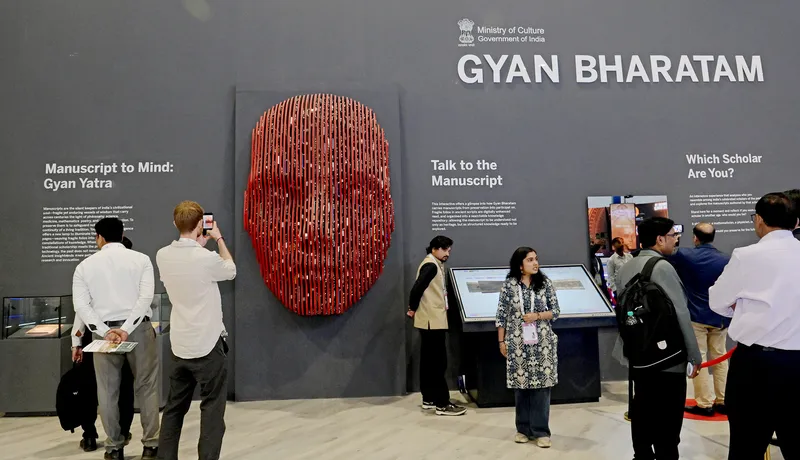
New Delhi emerged as the focal point of the global artificial intelligence (AI) conversation last week, from February 16–20, as the Indian AI Impact Summit drew massive crowds from across the world.
Inaugurated by Prime Minister Narendra Modi, the event brought together some of the most influential leaders in technology, including Sundar Pichai, the CEO of Alphabet; Sam Altman, the CEO of OpenAI; Dario Amodei, the CEO of Anthropic; Demis Hassabis, the CEO of Google DeepMind; and Mukesh Ambani, Chairman of Reliance Industries.
Over five days, the summit saw more than $250 billion commitments in infrastructure, the debut of new foundational AI models, and major shifts in digital payment architecture designed for the agent-driven economy.
The event concluded on February 21 with a significant diplomatic milestone as representatives from 88 nations and international organisations endorsed the New Delhi Declaration on AI.
Here’s a roundup of every major investment, product launch, partnership, and policy commitment that was announced at the India AI Impact Summit in New Delhi.
Investments
Union IT minister Ashwini Vaishnaw disclosed that over $250 billion in combined public and private infrastructure commitments were linked to announcements during the summit, underscoring large-scale investor confidence in India’s AI infrastructure roadmap.
At the heart of these large industrial pledges is a clear strategic priority—affordable, local compute and green power—enabling India to host large workloads domestically and reduce foreign dependency.
Adani Group said it will invest $100 billion over the next decade to build AI-specialised, renewable-powered data centres across India, positioning the company as a major domestic provider of large-scale compute capacity and green energy for AI workloads.
Reliance Industries committed Rs 10 lakh crore over seven years to develop multi-gigawatt AI-ready data centres, expand national edge compute infrastructure, and integrate large scale renewable energy. The company describes this as connecting India to the “Intelligence Era” and reducing dependence on overseas compute. This is a strategic, domestic play to lower AI compute costs and deliver low-latency services nationwide.
Microsoft said it is on track to invest $50 billion by 2030 to expand AI infrastructure, skilling, and multilingual capabilities across the Global South, with India singled out as a major focus. The commitment includes cloud and skilling programmes aimed at equipping teachers and public servants and expanding data-centre capacity that supports sovereign and local deployments.
Microsoft also outlined partnerships to skill tens of millions (including Elevate for Educators) and support public-sector AI platforms; the company’s skilling and cloud programmes are framed as public-private investments to accelerate adoption and responsible deployment.
Google announced a $15 billion AI hub in Visakhapatnam (Vizag) and an India–US. subsea cable initiative to deepen connectivity for AI workloads. The hub is presented as gigawatt-scale compute and an international gateway that will accelerate enterprise and research access to high-performance infrastructure.
Mumbai-based neo-cloud provider Neysa secured a Blackstone-led equity commitment of up to $600 million (with co-investors) and plans to raise additional debt to scale GPU capacity. The deal gives Blackstone a majority stake and signals rapid private-capital mobilisation to build locally hosted GPU capacity for enterprises and sovereign use cases.
Launches
As infrastructure commitments scale, a parallel wave of model-building and applied AI launches is beginning to define India’s domestic capability stack—spanning foundational models, rack-scale compute blueprints, and sector-specific deployments.
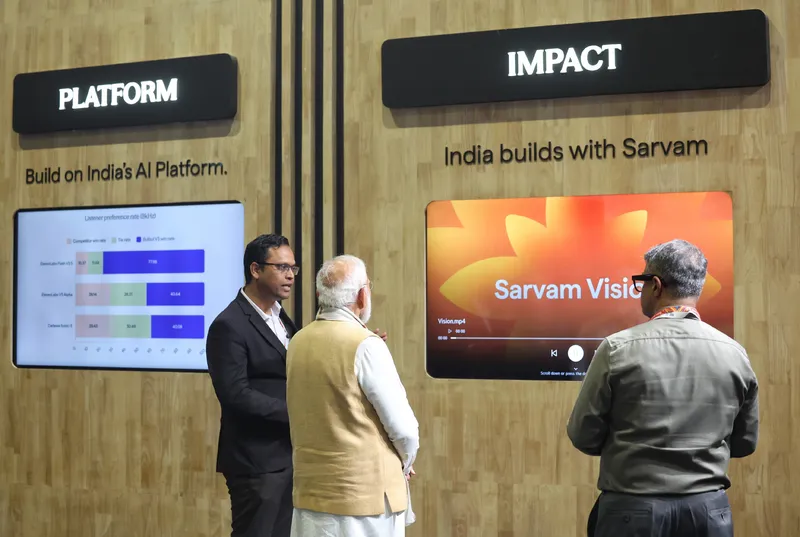
Pratyush Kumar, co-founder and CEO of the Bengaluru-based startup Sarvam AI, interacted with Prime Minister Narendra Modi at the summit (From PIB)
Sarvam AI unveiled its highly-anticipated 30-billion and a 105-billion parameter models, both trained in India. The company has also received large GPU subsidies and H100 allocations under government programmes. These models are pitched for efficient, high-context reasoning and for powering local language and agentic applications.
BharatGen announced Param2, a 17B Mixture-of-Experts multilingual foundational model supporting 22 Indian languages and targeted at government, education, healthcare, and cultural-digitisation use cases. It is presented as a core element of India’s sovereign model stack.
AMD and Tata Consultancy Services (through a TCS subsidiary) announced a collaboration to co-develop “Helios”, a rack-scale AI infrastructure blueprint powered by AMD MI455X GPUs and EPYC CPUs to accelerate rack-and-campus scale deployments in India.
Gnani.ai unveiled a self-cloned Digital Human (HumanOS) platform for voice+video customer engagement, emphasising multilingual, low-latency conversational experiences aimed at financial inclusion and high-volume onboarding (vKYC) scenarios. This is notable for operationalising multimodal AI in regulated sectors.
Partnerships
Infosys entered into a strategic collaboration with Anthropic to integrate Claude models into Infosys’ Topaz AI suite. The agreement included the creation of an Anthropic Centre of Excellence for regulated sectors (telecom, financial services, manufacturing). The tie-up targets enterprise agentic workloads requiring compliance and domain expertise.
Tata Group, Tata Consultancy Services (TCS), and OpenAI have entered into a multi-dimensional partnership to deliver AI-led solutions in multiple areas.
The partnership spans areas such as internal use of OpenAI’s ChatGPT platform, joint go-to-market initiatives, building agentic solutions, leveraging TCS’ data centres, and social impact solutions, said a statement from TCS issued on the stock exchanges.
Fintech companies used the summit to showcase how AI is moving payments from static checkouts to intelligent, embedded financial workflows.
Pine Labs said it is integrating OpenAI decision-making into payment and merchant flows to enable autonomous commerce workflows—a reasoning layer paired with Pine Labs’ payment rails to automate negotiation, settlements and other transaction operations for merchants. This is pitched to enable new agentic fintech products.
Razorpay rolled out Agentic Payments in partnership with NPCI to enable UPI-based purchases inside chat/assistant interfaces and pilots with major delivery platforms. The integration reduces friction by keeping discovery and payment inside the same conversational flow, which demonstrates payments infrastructure adapting to conversational and agentic commerce.
Cashfree launched Cashfree Here, a payments extension designed to embed UPI and card checkout inside AI apps (OpenAI Apps SDK, Anthropic MCP), with passkey-based biometric auth for cards. The product aims to remove redirect friction and make in-chat commerce seamless.
PhonePe launched an AI-powered natural-language search built on Microsoft Foundry to let users navigate and pay via voice/text intent, combining on-device inference with cloud to keep transaction data confined to the app.
Sarvam announced a partnership with Qualcomm to bring its AI models to edge devices such as smartphones, wearables, and XR. The collaboration also includes plans for an India-designed smart wearable, signalling a device-plus-model strategy aimed at expanding access to Indian language AI at the edge.

Policy
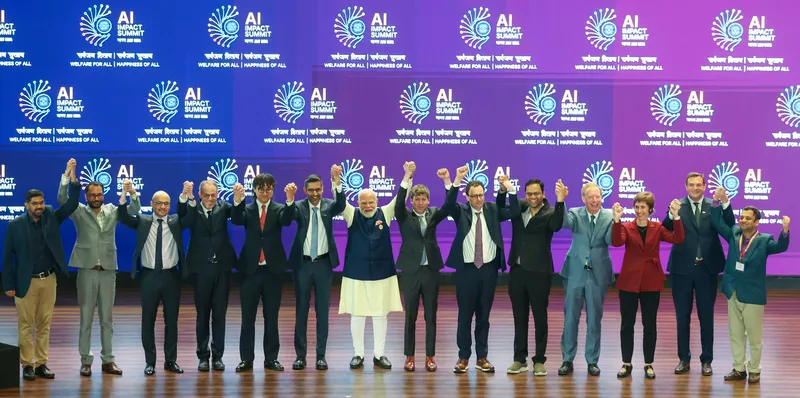
The event closed with the endorsement of the New Delhi Declaration that 88 countries and organisations committing to inclusive AI, democratised access to foundational resources, and multinational cooperation on trustworthy frameworks. The declaration places emphasis on equitable diffusion and development-oriented AI use.
Pax Silica / US-India cooperation on critical minerals and AI supply chains
India formally joined the Pax Silica initiative to strengthen resilient supply chains for critical minerals and AI ecosystems, signalled as a strategic step to reduce concentrated dependencies and secure inputs essential to semiconductor and AI infrastructure. This aligns supply-chain policy with the country’s sovereign AI ambitions.
Frontier AI companies and Indian innovators made voluntary commitments to publish anonymised adoption insights, strengthen multilingual/contextual evaluation, and support evidence-based policymaking on jobs and skills, an outcome framed to balance innovation with accountability.
India’s government-backed AI funds and subsidy programmes (including GPU subsidies and a state-backed VC facility) were highlighted as active policy levers supporting local model-building and infrastructure financing. These measures were repeatedly cited as catalysts for the private commitments announced at the summit.
Author

prakhar@affmantra.com
Related Posts

8 Powerful Aldous Huxley quotes on society and solitude
Aldous Huxley remains one of the most influential thinkers of the twentieth century. While many readers know him as the author of...
Read out all
Kunal Kapoor launches MetaGO, a doctor-led metabolic health platform
Actor and entrepreneur Kunal Kapoor has launched MetaGO, a doctor-led metabolic health platform, betting that India’s rising burden of obesity and related...
Read out all
Pronto extends series B to $45M at $200M valuation
- 0
- 686 words
Home services startup Pronto has raised an additional $20 million in an extension of its Series B round, taking the total financing...
Read out all
Swiggy, magicpin, Zomato see food delivery regain growth momentum in December qtr
- 0
- 317 words
India’s top three food delivery players, Swiggy, magicpin, and Zomato, regained growth momentum in the October-December period after a period of slower...
Read out all
Health, safety, AI: test your business creativity with Edition 222 of our weekly quiz!
- 0
- 760 words
Lateral Sparks, the weekly quiz from YourStory, tests your domain knowledge, business acumen, and lateral thinking skills (see the previous edition here)....
Read out all
PhonePe’s merchant network cross 47 million businesses ahead of IPO
- 0
- 423 words
As PhonePe prepares for its Initial Public Offering (IPO), disclosures in its updated Draft Red Herring Prospectus (DRHP) shed light on the...
Read out all