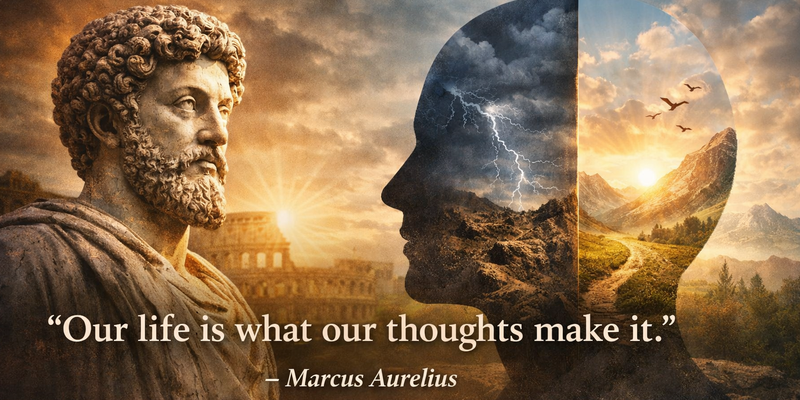
More than 1,800 years ago, Roman emperor and Stoic philosopher Marcus Aurelius wrote a simple yet profound truth: “Our life is what our thoughts make it.” In today’s fast-paced and often unpredictable world, this insight feels more relevant than ever.
At its core, the quote reflects a central Stoic belief — that while we cannot always control external events, we can control how we interpret and respond to them. Our perceptions shape our reality far more than circumstances themselves.
The power of perception
Two individuals can face the same setback and walk away with completely different experiences. One may see failure, while the other sees feedback. One may perceive uncertainty as threat, while another interprets it as opportunity.
The difference lies not in the situation, but in the mindset.
Marcus Aurelius believed that thoughts are the lens through which we view the world. If that lens is clouded by fear, doubt, or negativity, life begins to feel restrictive and overwhelming. If it is shaped by resilience, curiosity, and purpose, the same world becomes a place of growth.
In modern psychological terms, this aligns with cognitive framing — the idea that the meaning we assign to events influences our emotions and decisions.
Why mindset shapes outcomes
In professional and personal life alike, thinking patterns influence behaviour. A person who believes challenges are temporary is more likely to persist. Someone who views obstacles as permanent often withdraws.
For entrepreneurs, this distinction is particularly critical. Markets fluctuate, competition intensifies, and uncertainty is constant. Yet, businesses are often built or broken not by external forces alone, but by how founders interpret adversity.
A setback viewed as a lesson leads to adaptation. The same setback viewed as defeat leads to stagnation.
In this sense, thoughts do not just reflect reality — they actively construct it.
From philosophy to everyday practice
Marcus Aurelius did not advocate for blind optimism. Stoicism is not about pretending everything is fine; it is about recognising what lies within one’s control.
Practically, this means focusing on effort over outcome, response over reaction, and perspective over panic.
When delays occur, the thought can be “this is frustrating but manageable” instead of “everything is falling apart.”
When criticism arises, it can become “useful feedback” rather than “personal attack.”
These shifts may seem subtle, yet over time they shape confidence, decision-making, and resilience.
A guide for modern resilience
In an era marked by information overload, social comparison, and constant pressure, Marcus Aurelius’ words offer a grounding principle. External success, validation, and stability remain uncertain. Internal clarity, however, can be cultivated.
Life inevitably presents difficulties. But whether those difficulties become burdens or building blocks depends largely on interpretation.
The Stoic insight reminds us that we are not merely passive recipients of circumstance. We are active participants in shaping meaning.
Ultimately, while we may not control what happens to us, we do influence what it becomes in our lives.
And often, the difference between struggle and strength begins with a single thought.
Author

prakhar@affmantra.com
Related Posts

Kunal Kapoor launches MetaGO, a doctor-led metabolic health platform
Actor and entrepreneur Kunal Kapoor has launched MetaGO, a doctor-led metabolic health platform, betting that India’s rising burden of obesity and related...
Read out all
Pronto extends series B to $45M at $200M valuation
- 0
- 686 words
Home services startup Pronto has raised an additional $20 million in an extension of its Series B round, taking the total financing...
Read out all
Swiggy, magicpin, Zomato see food delivery regain growth momentum in December qtr
- 0
- 317 words
India’s top three food delivery players, Swiggy, magicpin, and Zomato, regained growth momentum in the October-December period after a period of slower...
Read out all
Health, safety, AI: test your business creativity with Edition 222 of our weekly quiz!
- 0
- 760 words
Lateral Sparks, the weekly quiz from YourStory, tests your domain knowledge, business acumen, and lateral thinking skills (see the previous edition here)....
Read out all
PhonePe’s merchant network cross 47 million businesses ahead of IPO
- 0
- 423 words
As PhonePe prepares for its Initial Public Offering (IPO), disclosures in its updated Draft Red Herring Prospectus (DRHP) shed light on the...
Read out all
Inside Etah’s Bell Workshops: Ghungroos, Temple Bells, and More
- 0
- 375 words
In Etah, Uttar Pradesh, sound is shaped through metal. Temple bells that mark prayer time, ghungroos tied to a dancer’s ankles, school...
Read out all