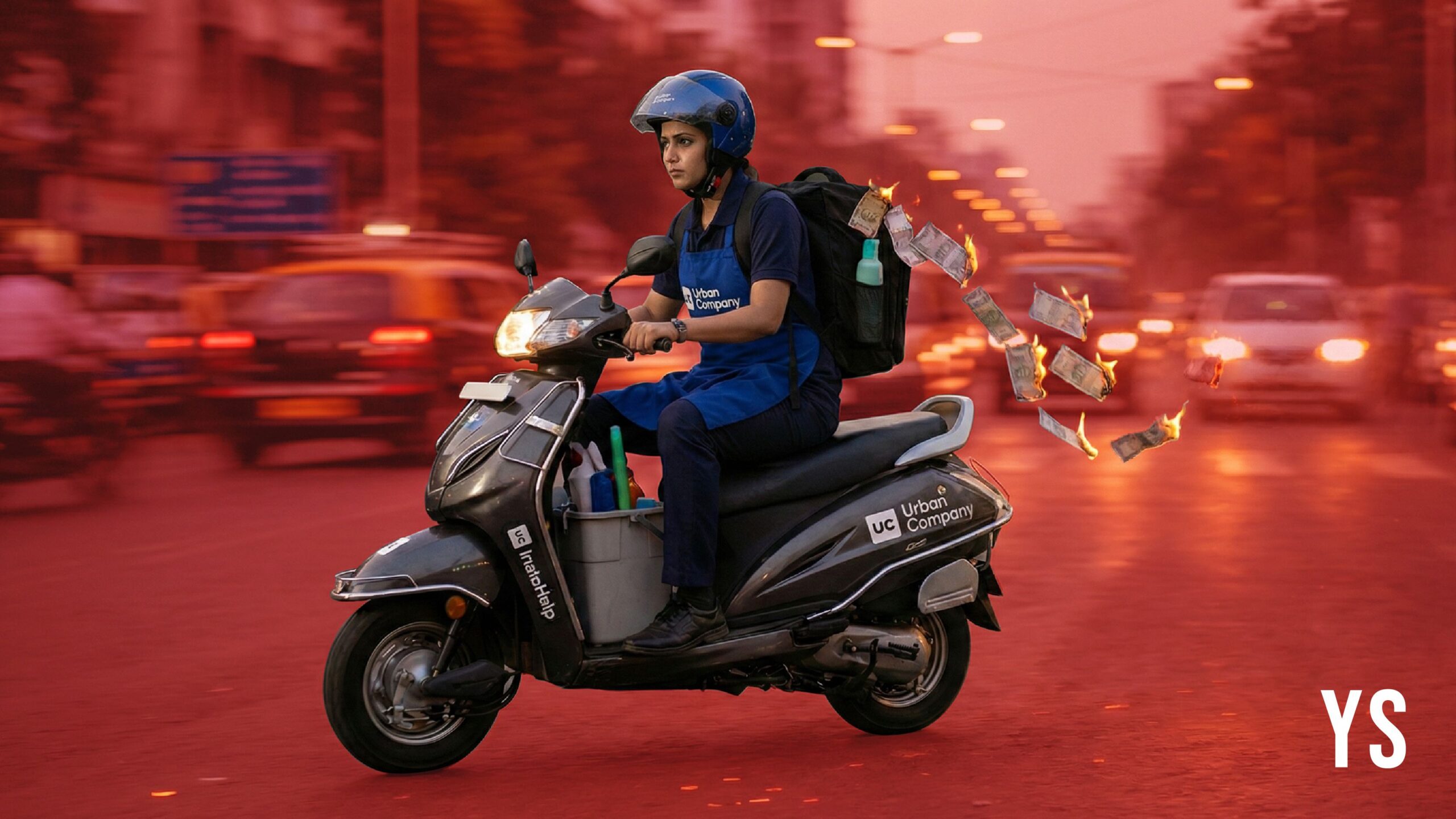
Urban Company’s quick housekeeping bet, InstaHelp, crossed 50,000 daily bookings on Sunday, 22 February, less than a year after it was first piloted in Mumbai, the company said in a press release.
The vertical, which offers cleaning, dishwashing, laundry and meal preparation in 10–15 minutes, is now live across select micro-markets in five metros—Mumbai, Bengaluru, Delhi NCR, Hyderabad and Pune, and is witnessing strong demand.
“Crossing 50,000+ daily bookings reflect strong consumer demand for reliable, on-demand housekeeping services. We are investing to build a large, high-frequency category that deepens platform engagement and strengthens long-term growth with results starting to become visible with respect to improving unit economics and growing repeat usage,” said Abhiraj Singh Bhal, CEO and Co-founder, Urban Company.
Hitting 50,000 daily bookings (a peak-day figure) is a symbolic milestone. While not a like-to-like comparison, Urban Company said its core India consumer services business took about six years to reach a similar scale.
But as The CapTable reported earlier today, scale is only one part of the story.
In Q3 FY26, InstaHelp clocked 1.61 million orders and Rs 28 crore in net transaction value, but also reported an adjusted EBITDA loss of Rs 61 crore.
The company highlighted one bright spot during its earnings call earlier this month: loss per order nearly halved in a single quarter, from Rs 760 in Q2 to Rs 381 in Q3.
Even so, Urban Company has been unusually candid in admitting that it still doesn’t know what steady-state profitability will look like for this business, or how long it will take to get there.
Scale is coming fast. Profits aren’t.
From Urban Company’s perspective, InstaHelp is still very much in learning mode. The company is focused on expanding supply in dense micro-markets, improving partner utilisation, and pushing up average order values.
In its earnings call, Bhal said the business is “micro-market heavy and micro-market dense,” with even smaller catchments than its core services business, meaning execution depends heavily on density, demand and partner reliability.
Building a quick home-services platform, in that sense, is like running Urban Company, Zepto, and Uber rolled into one. The challenges multiply, not add up, as The CapTable wrote last August.
The 50,000-daily-bookings milestone comes on the back of rapid quarter-on-quarter growth. The vertical more than doubled its order volumes in Q3, and the company says customer adoption and retention in older micro-markets is “very encouraging.”
But this growth is still being fuelled by low prices. Today, services are priced at Rs 149, sometimes as low as Rs 49. That keeps volumes accessible, but profitability nearly impossible.
An executive who spoke to The CapTable said the internal view is that average order value likely needs to land somewhere between Rs 300 and Rs 700 for the model to approach break-even. Bhal, too, said on the earnings call that AOV needs to rise to about 1.8–2x current levels for InstaHelp to break-even.
Executives also acknowledge that usage is still uneven.
Roughly 30–40% of demand comes from segments like bachelors and working women who batch chores and then book a service. The remaining 60% is still driven by emergency or occasion-based needs—when a regular househelp is on leave, guests are coming over, or extra cleaning is required. That’s very different from grocery or food delivery, where daily or weekly habits drive predictable volumes.
Strip away the momentum, and a harder question emerges: a business that has been running for nearly a year, burning tens of crores a quarter, still cannot tell investors how much it will ultimately cost to build, when it will stop bleeding, or even what a “good” outcome looks like.
For now, Urban Company doesn’t have the luxury of sitting this out. Competition is heating up, and consumer behaviour is clearly shifting.
Hitting 50,000 daily bookings shows InstaHelp has found demand. Whether it can turn that demand into a stable, profitable business is the much harder question. And one even the company admits it’s still learning to answer.
Author

prakhar@affmantra.com
Related Posts

8 Powerful Aldous Huxley quotes on society and solitude
Aldous Huxley remains one of the most influential thinkers of the twentieth century. While many readers know him as the author of...
Read out all
Kunal Kapoor launches MetaGO, a doctor-led metabolic health platform
Actor and entrepreneur Kunal Kapoor has launched MetaGO, a doctor-led metabolic health platform, betting that India’s rising burden of obesity and related...
Read out all
Pronto extends series B to $45M at $200M valuation
- 0
- 686 words
Home services startup Pronto has raised an additional $20 million in an extension of its Series B round, taking the total financing...
Read out all
Swiggy, magicpin, Zomato see food delivery regain growth momentum in December qtr
- 0
- 317 words
India’s top three food delivery players, Swiggy, magicpin, and Zomato, regained growth momentum in the October-December period after a period of slower...
Read out all
Health, safety, AI: test your business creativity with Edition 222 of our weekly quiz!
- 0
- 760 words
Lateral Sparks, the weekly quiz from YourStory, tests your domain knowledge, business acumen, and lateral thinking skills (see the previous edition here)....
Read out all
PhonePe’s merchant network cross 47 million businesses ahead of IPO
- 0
- 423 words
As PhonePe prepares for its Initial Public Offering (IPO), disclosures in its updated Draft Red Herring Prospectus (DRHP) shed light on the...
Read out all